


The Next Bitten Apple
Nine days into the job, John Ternus borrowed Steve Jobs' most famous line — and unfolded a $1,999 phone.
He said "one more thing." Then he unfolded a $1,999 phone. Nine days into the job, John Ternus made his opening move as Apple's chief executive.
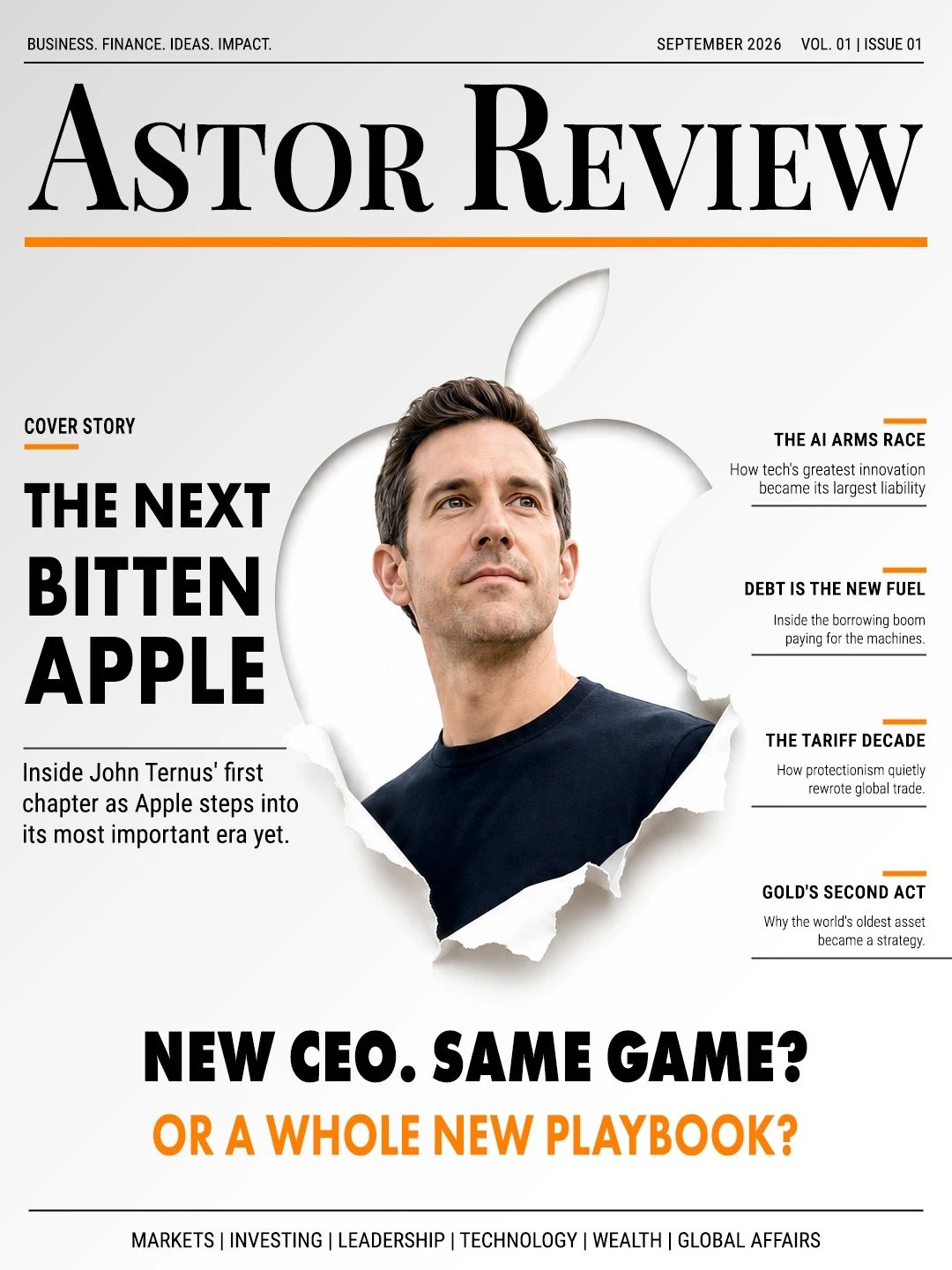
Astor Review Awards 2026
Best Emerging Broker, Entrepreneur of the Month, and Digital Creator of the Month. Recognition is editorial — pick a cover to see who was named.
Inside Issue 01
Nine pieces across finance, markets and policy — each sourced entirely from the public record, framed as what happens next rather than what happened.
Nine days into the job, John Ternus borrowed Steve Jobs' most famous line — and unfolded a $1,999 phone.
The ECB on 10 September, the Fed on 16 September — and for the first time in three years, nobody is arguing about cuts.
Protectionism stopped being an event and became the operating environment — and it's already in the price of a phone.
The spending arrived first. The revenue is still catching up. One full-spread chart on the largest bet in corporate history.
Who is financing the AI build-out, and what changes when the next move in rates isn't down.
Where decentralised finance actually stands — settlement infrastructure, regulation, institutional flows.
Not the biggest audiences — the people who changed what other people understood.
A record high, a hard policy reversal, and India quietly unwinding a decade-long experiment.
Olympus Capital, recognised for building across four jurisdictions from day one — and nominations for the next award are open.
Notable appointments across finance and fintech this month — and where to send yours.
Chart of the Month
There is no serious argument about how much is being spent on AI infrastructure — the major technology companies' own disclosures show capital expenditure rising every quarter for two years. Disclosed AI revenue has risen too, from a much smaller base, on a gentler curve. The gap between those two lines is the largest bet in corporate history, and it no longer stays confined to the technology sector — this issue traces it into the price of an iPhone (page 6) and the terms of a corporate bond (page 14).
September at a glance
The month framed as what happens next, not what already happened — from central bank calendars to product events and policy diaries.
John Ternus's first keynote as CEO — nine days into the job. 9 September.
Apple's first foldable, the iPhone Duo. Ships 23 October.
Ternus's pay is tied to beating the S&P 500 — not just growing Apple.
Tim Cook's package as executive chairman — roughly 80% of his successor's.
10 September. Markets pricing a 25bp hike to 2.50% — not a cut.
16 September. Odds of a hike near 50–65% since Jackson Hole.
A record high, then a pullback — while central banks kept buying.
AI capex keeps climbing. The market has stopped assuming revenue catches up on its own.
Huawei and Xiaomi shipped foldables the day before Apple's keynote.
Budgets, boards and Q4 plans — all landing inside the same four weeks.
What Goes In Every Issue
Every Finance issue runs to the same skeleton, front to back — so the reader always knows where things live and we build once, then reuse for 24 issues a year.
Masthead, cover line, cover image. One face, one line, nothing competing.
Contents list with page numbers, publisher line, editorial policy one-liner.
A signed letter framing the issue. Sets the tone for everything after.
The month framed as what happens next — finance, tech, policy, markets.
One full-spread data visual. Exports standalone as a social asset.
Four-page lead. The person, company or shift that defines the month.
Fed, ECB and regional policy, and what each decision changes.
Oil, gas and commodity moves and their transmission into inflation.
Issuance, spreads, and who is financing what.
Protocol-level developments, regulation, institutional flows.
Five figures who moved the business conversation this month.
Rotating slot — global affairs, gold, trade or a company deep-dive — plus career moves, outreach page, next-issue teaser.
Two Editions · One Standard
Same masthead, same discipline — different accent. Each edition is 24 pages, mobile-legible, exported for print and web.
15th of every month
1st of every month
How Every Issue Is Built
From theme lock to podcast episode. Same twelve stages, every month — which is what makes 24 issues a year survivable.
Theme, story list, word counts, cover subject approached.
Signed briefs, written deadlines, commissioning locked.
Free-features outreach for this issue — no fee, either direction.
Interview requests out. Chart data gathering begins.
All interviews completed and transcribed. Cover story drafted.
All copy in. Hard contributor deadline — no exceptions.
Every number, name, title and claim verified. Non-negotiable.
Every image cleared. Full layout complete. Cover designed.
Legal read, disclosure check, mobile and desktop pass.
Social pack built, newsletter scheduled, web articles staged with SEO fields.
Newsletter sends. Everyone featured is tagged and messaged.
Podcast episode with the cover subject. Performance review — opens, reads, shares, subscribers.
How the Website Is Built
The site is the magazine's front door, its archive, and its recruiting tool for the next issue's features. Every page below has a specific job — no orphan pages, no vanity sections.
/Latest issue cover dominant. Featured articles. Newsletter above the fold. Both editions visible.
/issue/…Cover, contents, every article linked, PDF download.
/…/articleSingle article. Byline with photo. Share buttons. Related articles.
/issues/Every past issue as a cover grid, filterable by edition.
/newsroom/Dispatches and press updates between issues — quick takes that don't wait for the 1st or 15th.
/awards/The current winner, what each category rewards, and where nominations go.
/finance/All finance content, edition description, subscribe to this edition only.
/marketing/All marketing and business content, subscribe separately.
/about/What Astor Review is, who runs it, the Amigoz Group publisher statement.
/editorial-policy/Free-features policy, Partner Content labelling, corrections policy.
/get-featured/How features work, influencer criteria, submission form.
/subscribe/ · /advertise/Standalone signup with edition choice. Rate card, formats.
The Room We're Built In
The Economist, Monocle, HBR, Bloomberg Businessweek, FT Graphics — the reference points, not the imitation.
Editorial Policy
Editorial coverage is not for sale. Paid placement is labelled Partner Content and is never called a feature.
No interviews required. Every fact traceable to a named public source, and every date verified.
If a figure cannot stand up to scrutiny, we describe the direction. Ranges before wrong numbers.
Get Featured
Business leaders and creators are considered on the same standard — a founder with 50 staff or a creator with 500,000 followers, one bar. No fee, either direction. If someone pays, it is Partner Content, it is labelled, and it is never called a feature.
Submit for consideration →On at least one primary platform, verified directly — not just claimed.
Teaches, informs, or moves an industry. Reviewed on recent posts, not follower count alone.
Consistent with audience size. Bought followings read as bought and are declined.
Business, finance, marketing, AI or tech. Not general lifestyle.
Ten minutes of homework, every time. No exceptions.
Free · Global · Twice Monthly
Issue 02 (Finance) drops 15 October 2026. One email a month, no tracking, no nonsense — just the magazine, the day it publishes.
Or apply to Get Featured in a future issue